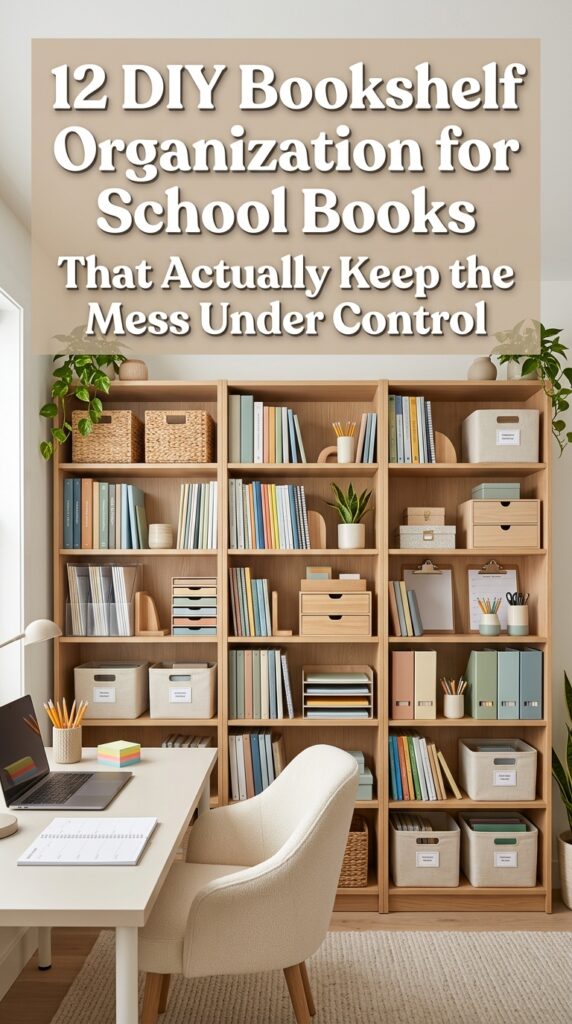
School books have a strange superpower. You neatly stack them on a shelf, walk away for two days, and somehow they multiply into an avalanche.
I’ve been there more times than I’d like to admit. One minute everything looks organized, and the next you’re digging through a pile of notebooks just to find yesterday’s math workbook.
The good news? You don’t need an expensive custom bookshelf to fix the problem. A few simple DIY bookshelf organization ideas can completely change how your study space looks and functions.
Better yet, most of these projects cost very little and only take an afternoon to finish.
If you’re ready to stop playing hide-and-seek with school books, let’s get started.
1. Create Color-Coded Book Sections
Color coding sounds almost too simple, but it works surprisingly well.
Assign each school subject its own color and organize books accordingly. You can use colored adhesive labels, washi tape, or even colored cardstock dividers.
For example:
- Blue: Mathematics
- Green: Science
- Yellow: English
- Red: History
- Purple: Art
You’ll find books much faster because your brain naturally remembers colors.
Amazon Product Recommendation
Scotch Colored Book Repair Tape
This colorful tape sticks well, lasts for months, and instantly turns ordinary books into organized categories.
2. Build Wooden Book Dividers
Books love leaning against each other until they eventually collapse like dominoes.
Simple DIY wooden dividers keep everything standing upright while giving your bookshelf a clean, built-in appearance.
You only need:
- Small plywood scraps
- Wood glue
- Sandpaper
- Paint or wood stain
IMO, stained natural wood looks better than bright paint because it matches almost any room. 🙂
Amazon Product Recommendation
Rust-Oleum Ultimate Wood Stain
It gives inexpensive wood a premium finish without requiring professional woodworking skills.
3. Turn Magazine Holders into Vertical Book Organizers
Ever noticed how textbooks rarely fit neatly on shelves?
Magazine holders solve that problem instantly.
Instead of stacking books horizontally, stand them vertically inside sturdy magazine files.
They’re perfect for:
- Workbooks
- Thin textbooks
- Revision guides
- Practice papers
Even better, label each holder clearly so everyone knows where everything belongs.
Amazon Product Recommendation
Bankers Box Magazine File Holders
They’re durable, affordable, and hold surprisingly heavy textbooks.
4. Install Adjustable Shelf Risers
Sometimes the biggest problem isn’t the books.
It’s the wasted vertical space.
Shelf risers create an extra storage level without buying another bookshelf.
I installed a set on my own shelf years ago, and I honestly wondered why I hadn’t done it sooner.
Benefits include:
- Double the storage space
- Better visibility
- Easier organization
- Less clutter
Amazon Product Recommendation
Simple Houseware Expandable Shelf Organizer
It adjusts to different shelf widths and works perfectly for books and notebooks.
5. Make DIY Book Bins from Wooden Crates
Wooden crates never seem to go out of style.
Turn inexpensive crates into movable book bins by sanding them smooth and adding caster wheels.
These rolling bins work especially well for:
- Library books
- Homework folders
- Seasonal textbooks
- Art supplies
Ever wondered why teachers love rolling storage? Because it simply makes life easier.
Amazon Product Recommendation
These heavy-duty wheels transform ordinary wooden crates into mobile organizers.
6. Add Floating Shelves Above the Desk
Why let empty wall space go to waste?
Floating shelves create extra storage while keeping your desk clear.
Store books you don’t use every day on higher shelves and keep daily essentials within arm’s reach.
Keep these items above your desk:
- Reference books
- Dictionaries
- Reading novels
- Extra notebooks
Less clutter on the desk means more room for studying.
Amazon Product Recommendation
These sturdy shelves support heavy books while adding a modern touch to any study area.
7. Label Everything Clearly
Labels sound boring.
They’re also incredibly effective.
You don’t need a fancy label maker either.
Try using:
- Chalkboard stickers
- Printable labels
- Vinyl decals
- Handwritten tags
When every shelf has a purpose, nobody wastes time guessing where books belong.
FYI, this trick also keeps younger kids from stuffing random books wherever they fit.
Amazon Product Recommendation
It creates clean, professional labels that stay readable for years.
8. Create a Homework Station on One Shelf
Instead of spreading school supplies across an entire room, dedicate one bookshelf shelf to homework.
Include:
- Pencil holder
- Calculator
- Highlighters
- Sticky notes
- Notebook
- Charging station
Everything stays together, and homework suddenly feels much less chaotic.
Well…the homework itself doesn’t improve, but at least you’ll find your pencil.
Amazon Product Recommendation
It combines compartments for pens, notebooks, scissors, and office supplies in one compact organizer.
9. Use Clear Storage Boxes for Small Supplies
Tiny school supplies disappear faster than socks in the washing machine.
Clear storage boxes solve that mystery.
Store items like:
- Erasers
- USB drives
- Flashcards
- Glue sticks
- Index cards
- Binder clips
Because the containers stay transparent, you’ll always know what’s inside.
Visibility saves time every single day.
Amazon Product Recommendation
They’re stackable, durable, and ideal for organizing school accessories.
10. Add Pull-Out Book Baskets
Not every bookshelf needs to display every book.
Pull-out baskets hide visual clutter while keeping books easy to access.
These work especially well for:
- Children’s books
- Library books
- Homework folders
- Coloring books
Personally, I like woven baskets because they soften the look of a bookshelf and make the room feel warmer.
Amazon Product Recommendation
StorageWorks Woven Storage Baskets
These sturdy baskets slide smoothly on most shelves and look far more expensive than they actually are.
11. Build a Rotating Reading Shelf
This project takes a little more effort, but the result feels impressive.
Create a rotating bookshelf using a heavy-duty lazy Susan bearing attached beneath a square wooden platform.
The rotating design makes it easy to reach books from every side.
Materials you’ll need
- Plywood
- Lazy Susan bearing
- Wood screws
- Paint or stain
- Rubber feet
Ever spun one of these just because it’s fun? I definitely have. :/
Amazon Product Recommendation
Lazy Susan Turntable Bearing Kit
It supports heavy weight while rotating smoothly for years.
12. Organize Books by Frequency of Use
Not every school book deserves front-row seating.
Place frequently used textbooks at eye level and move less-used books toward the top or bottom shelves.
Here’s a simple system:
Top Shelf
- Archived textbooks
- Reference books
Middle Shelf
- Daily school books
- Homework notebooks
Bottom Shelf
- Large binders
- Storage boxes
- Extra paper
This simple adjustment makes everyday studying much more efficient.
Amazon Product Recommendation
These sturdy bins make it easy to separate books by subject or frequency of use.
Extra DIY Tips That Make a Big Difference
Small improvements often create the biggest results.
Consider adding these finishing touches:
- Use matching storage containers for a cleaner appearance.
- Leave 20% empty shelf space so books stay easy to remove.
- Dust shelves every couple of weeks to protect books.
- Rotate seasonal books to avoid overcrowding.
- Keep heavy textbooks on lower shelves for better stability.
- Store sentimental books separately if you rarely use them.
Your bookshelf doesn’t need to look like a furniture showroom. It only needs to work for your daily routine.
Common DIY Bookshelf Organization Mistakes
Even great organization systems fail when people make a few common mistakes.
Avoid these problems:
- Overstuffing every shelf
- Ignoring labels
- Mixing school supplies with random household items
- Buying organizers before measuring shelves
- Keeping books you no longer need
Remember, organization isn’t about owning more storage containers.
It’s about making your existing space work smarter.
Why DIY Bookshelf Organization Works So Well
DIY projects let you customize your bookshelf around your actual needs instead of forcing your books into generic storage.
Whether you build simple dividers, install floating shelves, or organize by subject, every improvement saves time and reduces frustration.
Better organization also creates a calmer study environment, and that can make homework feel just a little less overwhelming.
Start with one or two of these ideas this weekend instead of trying to tackle everything at once. Once you see how much easier it is to find the right book, you’ll probably wonder why you waited so long.
And if your bookshelf stays tidy for more than a week, you deserve to celebrate because that’s practically a miracle.